Vivian Harkness
Just DesertsVivian Harkness is one of the central practical figures at Grenadine Reef: a woman whose apparently modest duties sustain the estate’s larger moral and social project. Together with her sister Violet Harkness, she converts chaperonage, correspondence, household management, and vigilance into forms of protection and agency for women whose freedom is restricted by reputation, law, or past abuse. Her importance lies less in public prominence than in the networks she quietly maintains; again and again, Vivian stands between danger and the women in her care, while also carrying information between people who cannot safely meet or write directly.
Identity and Background
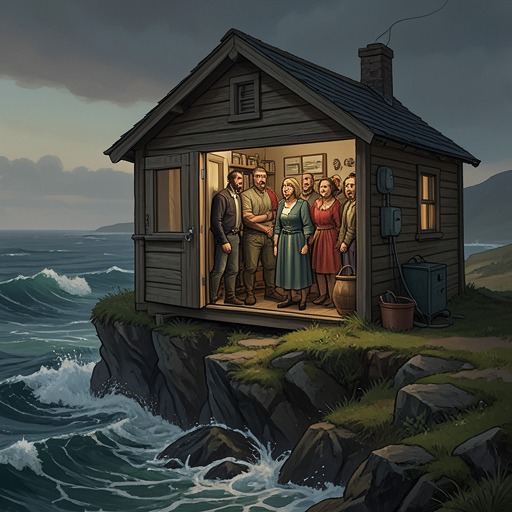
Vivian Harkness has worked for years at the Grenadine Reef dower house. Five years before Elizabeth Bennet’s early visits to Sir David Pentland, Vivian accompanied Violet when Violet needed to escape an employer. Instead of returning to service, the sisters remained under Mrs. Perkins’s direction and ran the dower house’s daily operations. Vivian’s history therefore links the refuge to the wider problem it addresses: women who have been subjected to male authority can find not only shelter there but also meaningful work and a continuing place within a female-supporting household.
The sisters’ position is practical rather than ornamental. They manage the dower house, transport women, accompany visitors, and carry out the delicate social labor required to make the refuge safe. Their work also places them close to both the estate’s residents and its male owner, yet the narrative repeatedly distinguishes consent and trust from command. When Sir David later asks whether they would move into the manor house, he makes clear that he is asking rather than ordering. That distinction matters to Vivian and Violet because their past experience has made male coercion a concrete danger rather than an abstract social concern.
Vivian is also part of the book’s transnational history through her close connection with Lady Radha Pentland. Elizabeth Bennet learns from both Madeline Gardiner and Lady Radha, describing Lady Radha as a woman born in India, kidnapped three times, gravely injured by pirates, and left unable to bear children. Vivian’s daily service at the estate places her within the household that receives and protects the consequences of that history. She is not merely an attendant to an English country-house plot; she belongs to an institution shaped by displacement, violence, recovery, and the refusal to let abused women disappear into silence.
Chaperonage and the Exchange of Letters
Vivian’s most important early function is to make Elizabeth’s relationship with Sir David possible without violating the strict rules governing an unmarried gentlewoman. Elizabeth cannot be alone with an unrelated man and cannot correspond with him directly. Vivian therefore waits with the phaeton, accompanies Elizabeth as chaperone, and remains close enough to establish propriety while withdrawing from the private conversation itself. Sir David can glance down the room and see Vivian quietly reading: present as a guarantee of respectability, but deliberately removed from the exchange she makes possible.
When weather prevents Elizabeth from visiting Grenadine Reef, Vivian becomes an intermediary in a carefully maintained chain of communication. Elizabeth writes to Vivian about the questions she intends to ask Sir David. Vivian repeats those questions to him; he discusses his answers and his own questions with her; then Vivian or Violet writes the material back to Elizabeth. The arrangement is described as a thin veneer of respectability, but its thinness does not make it useless. It enables two unrelated people to sustain a relationship through a system that officially denies them the ordinary means of correspondence.
Vivian’s role becomes especially significant after Lady Radha’s death. Sir David is nearly seventy-two, mentally sharp but physically slowing, and the twice-weekly visits from his unrelated granddaughter are the highlight of his week. He knows that without Elizabeth he might have fallen into despair after Radha was taken from him. Vivian and Violet preserve that connection during the winters, when travel is difficult, by reading Elizabeth’s letters aloud and preparing Sir David’s replies. When a packet of papers, including a thick letter, arrives at Grenadine Reef, Vivian is among those who bring the household’s continuing written life into the drawing room.
Elizabeth likewise finds the written channel easier than direct confrontation. When she is troubled by a major invitation and by the events surrounding it, she writes a long letter to Sir David through Vivian, recording her feelings and thoughts because she is unsure she could explain everything while sitting opposite him. Vivian’s mediation thus does more than transport information. It provides a transitional space in which Elizabeth can formulate difficult truths, while Sir David can receive them without the immediate pressure of face-to-face scrutiny.
Protection, Judgment, and Household Authority
Vivian’s work extends beyond etiquette into the physical protection of women. When Elizabeth drives toward Grenadine Reef after George Wickham’s death, Vivian is the person driving the phaeton during their brief period alone. Her later explanation of the refuge’s travel rules shows her command of its procedures: vulnerable women are afraid of men because of what they have endured, and when a single young woman leaves the dower house, three women travel together so that two can return safely. The rule turns collective movement into a security measure, making protection a matter of routine rather than improvised heroism.
Vivian also helps arrange the safe departure of women connected with the refuge. Sir David pays for Violet, Gladys, and Yvonne Smith to travel together to Liverpool, where Violet and Yvonne will be safe returning together. Vivian knows the ordinary safeguards but is surprised by the timing of that journey, since Chambers wanted to leave immediately on the Wednesday. Her response combines emotional awareness with logistical competence: she recognizes that the timing is strange, yet also understands how the household can manage the departure.
The sisters’ recovery is measured partly through their changing relationship to male workers. When Sir David asks whether they can tolerate living in the manor house, Vivian explains that even a few years earlier she would have been nervous around men. Through driving Elizabeth about the estate and serving as chaperones for her and Sir David, however, the sisters have learned that not all men resemble the man who imposed himself on Vivian. Familiarity with male staff around the stables and grounds has altered the conditions of their fear. The move is therefore not a demand that trauma be forgotten, but evidence that safety, repeated experience, and control over the terms of contact can make a different future imaginable.
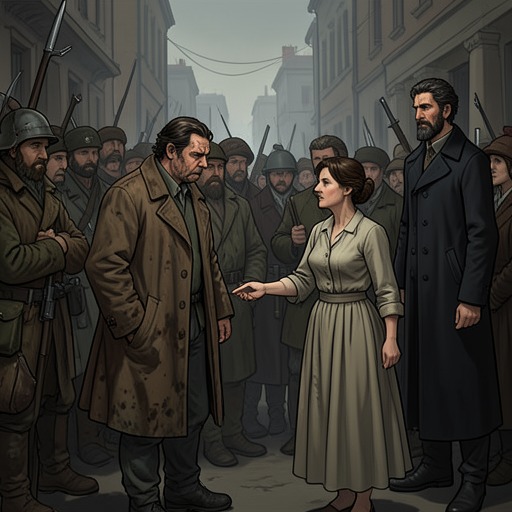
Vivian’s competence also becomes security work in its most literal form. When Elizabeth returns to Gracechurch Street, Vivian and Violet accompany her as companions and chaperones, while four additional bodyguards are assigned to the party. The sisters themselves are armed without Elizabeth’s knowledge: Vivian carries a knife, and Violet conceals two poniards as knitting needles. At Grenadine Reef, when Lady Catherine de Bourgh is present and her voice can be heard before she is seen, Vivian enters with the guards behind Elizabeth, helping create the disciplined show of strength through which Elizabeth confronts the intruder. The women who appear to be servants or chaperones are also prepared defenders.
From Service to Professional Work
Vivian’s relationship with Elizabeth gradually becomes more reciprocal and intellectually active. Elizabeth’s letters ask Vivian to transmit questions, record answers, and carry advice; Vivian and Violet do not simply repeat other people’s words but help structure the correspondence itself. When Elizabeth’s family and romantic circumstances become complicated, she and Sir David continue to rely on the sisters as trusted channels. Vivian’s presence makes communication possible while preserving both privacy and social legitimacy.
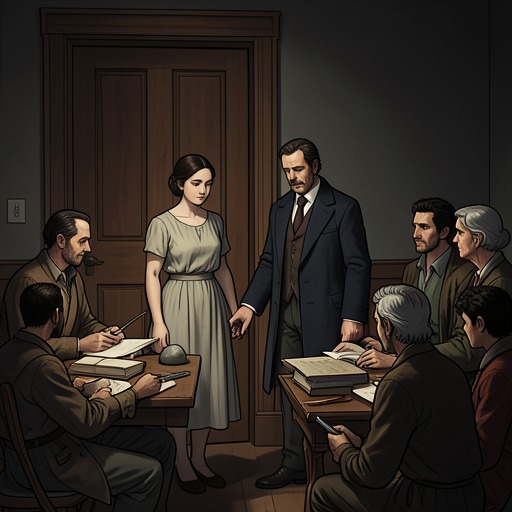
The household eventually recognizes that the sisters’ literacy and reliability deserve a more formal place. Sir David asks whether they would move into the main house and become secretaries. They are told that male servants will be present, but Vivian explains that they have become accustomed to seeing the staff and that their penmanship has improved through handling letters to and from Elizabeth. The proposed work offers advancement without requiring them to abandon the refuge’s values: their skills, acquired through years of protective domestic labor, become the basis for paid administrative responsibility.
After Elizabeth’s marriage, Fitzwilliam Darcy supports the arrangement. He has a secretary near Pemberley whose work will double because of the estates and investments brought into the marriage, and he considers Vivian and Violet suitable assistants for note-taking, correspondence, and general business duties. Mr. Upshaw, described as a decent man and the father of daughters, is expected to train them and include them in the increased volume of estate business. The transition marks a material change in status. Vivian is no longer confined to the invisible labor of service; her competence becomes recognized as an economic and professional asset.
Relationship with Elizabeth and Violet
Vivian’s bond with Elizabeth is founded on trust, discretion, and repeated acts of care. She chaperones Elizabeth, drives her to the estate, carries her questions, receives her letters, and helps preserve the relationship between Elizabeth and Sir David across distance and social restriction. Elizabeth, in turn, treats Vivian as someone whose judgment can receive intimate fears and complicated decisions. Their connection is neither a conventional friendship between social equals nor a purely formal employer-servant relation. It is a working alliance in which social difference coexists with moral confidence.
Violet is Vivian’s closest collaborator. The sisters escaped service together, ran the dower house together, and share responsibility for the correspondence that joins Elizabeth to Sir David. When one sister speaks or reads, the other is often prepared to write or take notes; when danger threatens, both are present and armed. Their partnership shows how the refuge’s protection depends on coordinated female labor rather than on a single heroic figure.
Their shared history also makes the later wedding gift significant. On the Wednesday night before Elizabeth’s wedding, when all four Bennet sisters are together, Vivian and Violet approach Elizabeth with a wrapped package. Violet blushes as Vivian produces it, and the sisters tell Elizabeth that the gift was made for her. The scene gives their relationship a ceremonial dimension: women who have long served as intermediaries and guardians claim a place in Elizabeth’s personal history, not only in the machinery of the estate.
Vivian Harkness therefore represents the quiet infrastructure of resistance. She turns rules of propriety into channels of communication, transforms refuge procedures into collective security, and converts service experience into secretarial work. Her arc is not a dramatic ascent from obscurity to public power; it is the gradual revelation that the labor dismissed as domestic, subordinate, or merely supportive is precisely what allows Elizabeth, Sir David, and the women of Grenadine Reef to survive, communicate, and choose their futures.